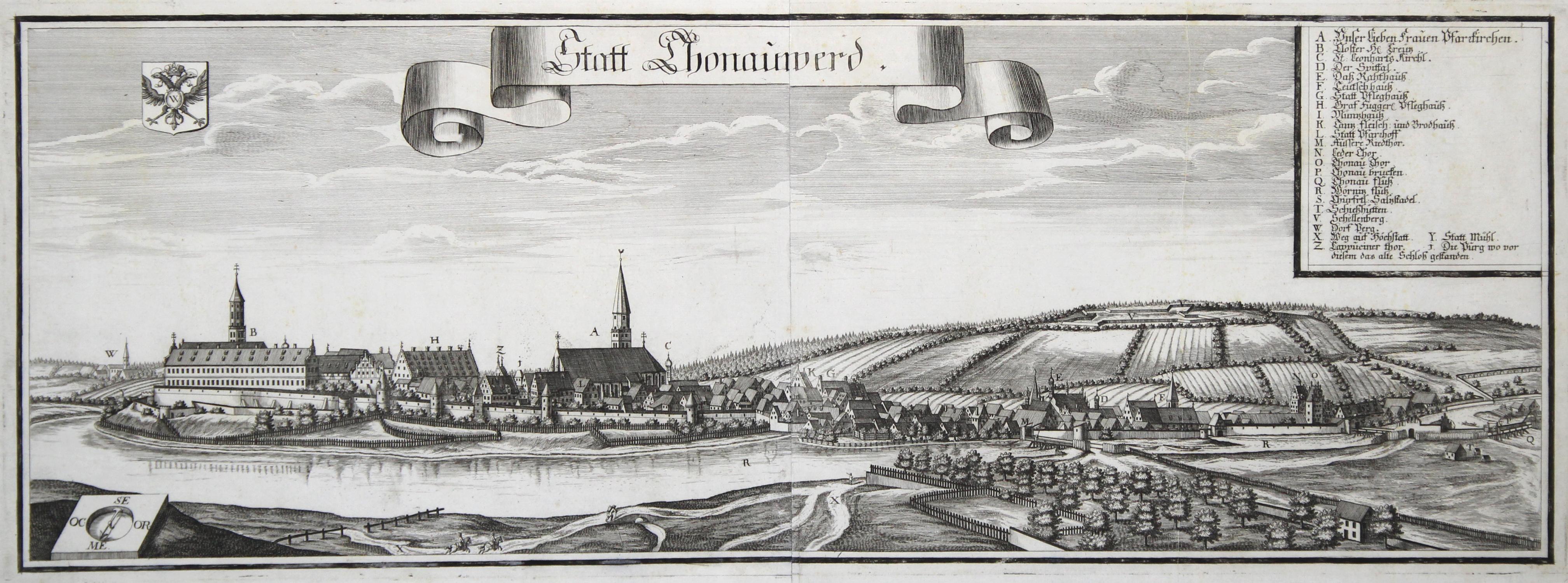
9./10. Oktober 2026
Enderlesaal
Kapellstraße 3
86609 Donauwörth
Die Tagung wird über Zoom online übertragen. Den Link zur Sitzung finden Sie hier.
LINK: https://uni-augsburg.zoom-x.de/j/62300700969?pwd=whEWpUjIcR5XyjglaM7fXWO9ikVDnC.1
KENNCODE (falls erforderlich): se6i.$
Programm
Freitag, 9. Oktober 2026 – Donauwörth, Enderlesaal
16:30–17:00 Uhr
Begrüßung
Franz Körndle und Ottmar Seuffert
17:00–17:30 Uhr
Jacob Hochbrucker und die Musik in der Region Donauwörth
Franz Körndle
17:30–18:00 Uhr
Early Pedal Harps in Venetian Sources: Evidence, Ambiguities, and Research Perspectives
Sofia Masut
18:00–19:00 Uhr
Von Donauwörth in die Welt: Aspekte der Musikermobilität und Migration im 18. Jahrhundert
Joachim Kremer
Im Anschluss
KONZERT: Musik für die frühe Pedalharfe
Maria Christina Cleary (Einfachpedalharfe)
Samstag, 10. Oktober 2026 – Donauwörth, Enderlesaal
9:00–9:15 Uhr
Grußwort
Christoph Lang
9:15–9:45 Uhr
The Use of the Italian arpa doppia in German Courts in the Late 17th Century. With a Special Reference to Canzonetten und andere Musikstücke by Wolfgang Caspar Printz (1679)
Chiara Granata
9:45–10:15 Uhr
„With our harps upon our backs“ – History, Repertoire and Playing Technique of the Hook Harp
Nancy Thym
10:15–10:45 Uhr
The Hochbrucker Hook Harp MIR 948 in the Germanische Nationalmuseum (GNM) Nuremberg
Véronique Musson-Gonneaud
10:45–11:00 Uhr
Coffee break / Kaffeepause
11:00–11:30 Uhr
Die Harfe 565 in der Sammlung alter Musikinstrumente in Wien
Franziska Bühl
11:30–12:00 Uhr
Vom historischen Instrument zum digitalen Modell: 3D-Scanning und computergestützte Analyse früher Pedalharfen
Susanne Bosche
12:00–12:30 Uhr
Understanding the 5 pedal harp
Mike Parker
12:30–14:30 Uhr
Lunch break / Mittagspause
14:30–15:00 Uhr
Hochbrucker’s Harp and the Culture of Appropriation
Robert Adelson
15:00–15:30 Uhr
From Hochbrucker to Erard: The Pedal Harp in the Context of Industrial Enlightenment
Panos Poulopoulos
15:30–16:00 Uhr
German Harp Makers and Musicians in Paris: the Construction of the Eighteenth-Century Harp Culture
Fanny Guillaume-Castel
16:00–16:30 Uhr
Coffee break / Kaffeepause
16:30–17:00
Mozart, Hochbrucker, Krumpholtz in Paris: A new musical language on the ‚harpe organisée‘
Maria Christina Cleary
17:00–17:30 Uhr
«Ah! que l’amour est chose jolie! » – Hochbrucker’s collections of Ariettes Op. 2–4 and other Parisian prints for harp and voice in the context of performance practice and musical culture (1750–1775)
Maximilian Ehrhardt
17:30–18:00 Uhr
Harfen-Geschichten des Sammelns und Bewahrens. Zu den Harfen des Musikinstrumenten-Museums (MIM) Berlin
Benedikt Brilmayer
Im Anschluss
KONZERT: Lieder zur Hakenharfe & Einfachpedalharfe
Nancy Thym (Hakenharfe und Einfachpedalharfe)
Abstracts
Neues aus der Hochbrucker-Familie und zur Musik in der Region Donauwörth
Franz Körndle
Neben den bekannten Mitgliedern der Donauwörther Familie Hochbrucker, nämlich Jacob mit seinen Söhnen Simon, Johann Christoph und Johann Baptist sowie den Harfenisten der in Tagmersheim ansässigen Familie des Elias Hochbrucker mit den Söhnen Franz Christian (Coelestin) und Michael wurden in jüngerer Zeit weitere Träger des Namens ermittelt. Seit 1690 war in der Region Donauwörth auch ein Johann Georg Hochbrucker zu finden.
In der Hochbrucker-Werkstatt wurden nicht nur Harfen gefertigt, sondern auch Saiten, die in den Verkauf gingen. Es interessiert daher auch, was über das Musikleben in der Stadt und in der Region bekannt ist.
„With our harps upon our backs“ – History, Repertoire and Playing Technique of the Hook Harp
Nancy Thym
The hook harp receives its name from the small metal hooks screwed into the neck which, when turned against a string, raise the pitch of that string by a semitone. We are acquainted with the hook harp primarily as the instrument of the German speaking Harfenmädchen or itinerant female harp players from the late 18th century through the early 20th century. But in Germany the hook harp was preferred in bourgeois society as well, even after the invention of the pedal harp, as is witnessed by the methods for hook harp published by J. C. G. Wernich (1772) and Johann Herbst (1792). The hook harp had a very unique playing technique, some elements of which are found in early single-action pedal harp technique. This presentation explores the history of the hook harp, its repertoire, construction, and playing technique, explains the function of the hooks and will attempt to clarify misconceptions as to its origins.
Die Harfe 565 in der Sammlung alter Musikinstrumente in Wien
Franziska Bühl
Als die Einfachpedalharfe 1942/43 in die Sammlung alter Musikinstrumente Wien kam, entdeckte man einen Zettel auf der Innenseite des Pedalkastens. „Hochbrucker / Donauwörth 1720“ stand darauf geschrieben. 2007 dokumentierte Beat Wolf die Harfe und stellte dabei Übereinstimmungen mit zwei weiteren frühen Pedalharfen fest, die sich jetzt in Paris und Zürich befinden. Auf Grundlage des Zettels in SAM 565 wurden sie ebenfalls Jakob Hochbrucker zugeschrieben. Jüngste Beobachtungen von Mike Parker gaben Anlass zur erneuten Untersuchung und Dokumentation der Harfe SAM 565, deren Ergebnisse hier vorgestellt werden sollen.
Vom historischen Instrument zum digitalen Modell: 3D-Scanning und computergestützte Analyse früher Pedalharfen / From Historical Instrument to Digital Model: 3D Scanning and Computer-Assisted Analysis of Early Pedal Harps
Susanne Bosche
3D digitization offers new possibilities for the study of historical musical instruments. Applied with appropriate technologies and procedures, it enables digital models to be used not only for documentation and presentation, but also for measurement, comparison, reconstruction, and computer-assisted analysis. At the same time, 3D data are measurement data and must therefore be critically assessed with regard to their accuracy and limitations.
We recently digitized a harp attributed to Hochbrucker and held at the Kunsthistorisches Museum in Vienna. The resulting digital model allows the instrument to be studied without further handling of the original and provides a basis for comparison with other harps. Computational methods can be used to derive highly precise construction plans for reconstructions, with an accuracy of approximately 0.1–0.3 mm depending on the quality of the underlying 3D data. The case of the Hochbrucker harp demonstrates how 3D digitization can connect traditional instrumentological research with digital methods, providing new opportunities for the measurement, comparison, reconstruction, and computer-assisted analysis of historical instruments.
Understanding the 5 pedal harp
Mike Parker
We are generally told that the pedal harp was invented, initially with five pedals, and only later increased to seven, with the implication that the five pedal harp was imperfect, and needed to be ‚perfected‘ before it became a truly useable instrument.
By examining surviving instruments with fewer than seven pedals, and discussing their provenance and how they could be used, I hope to encourage a deeper understanding of both the origin myths of the pedal harp, and the practical application of the partial-actioned instrument.
Hochbrucker’s Harp and the Culture of Appropriation
Robert Adelson
Jacob Hochbrucker’s invention of a pedal mechanism around 1697 laid the foundation for a tradition of harp making that endures to this day. Yet the pedal harp only took root in Paris around 1759, where a rapid expansion in performers, teachers, harp makers and composers coincided with the emergence of a distinct repertoire. This paper argues that the success of the pedal harp in France was not simply the result of technical innovation, but of cultural predisposition. Although the harp had been absent from French musical life during the late seventeenth and early eighteenth centuries, it retained a powerful symbolic presence within an imagined Arcadian world populated by shepherds, shepherdesses, and rustic musicians. The association of the harp with the pastoral was by no means exclusive to France, but the pedal harp emerged at a moment when French aristocratic culture developed a fascination with using „improved“ pastoral instruments in concert music. Hochbrucker’s invention therefore entered a cultural environment already predisposed to receive it. Situating the French reception of the pedal harp within broader patterns of the cultural appropriation of pastoral instruments not only reframes its early history but also clarifies distinctive features of its emerging repertoire and brings into focus a body of early pedal-harp music hitherto overlooked.
From Hochbrucker to Erard: The Pedal Harp in the Context of Industrial Enlightenment
Panos Poulopoulos
From its conception by Hochbrucker to its refinement by Erard, during the eighteenth century the pedal harp became a sophisticated, state-of-the-art musical instrument, incorporating several innovative engineering, technical, and aesthetic features. With its widespread adoption by professional and amateur musicians alike as well as with its inclusion in groundbreaking publications, such as Diderot’s Encyclopédie, the pedal harp was gradually transformed from a sounding device into a powerful symbol of taste, wealth and status. Interestingly, many of the concepts, materials and methods used in the design, construction, and decoration of pedal harps were borrowed from related crafts and trades involved in the manufacture of luxury goods, ranging from clocks and precision tools to textiles, pottery, and ornamental prints. By focusing on previously overlooked connections and interactions, this paper will discuss how the production of the pedal harp was influenced by various technological, economic, and sociocultural developments, while examining aspects of knowledge dissemination across sectors in the context of Industrial Enlightenment.
German Harp Makers and Musicians in Paris: the Construction of the Eighteenth-Century Harp Culture
Fanny Guillaume-Castel
When discussing the pedal harp in 18th century France, the figure of queen Marie Antoinette is frequently presented as a central figure in narratives of the instrument’s popularity. By the time she arrived at Versailles in 1770, however, a well-established pedal-harp culture had already developed in Paris. Introduced to the French capital from Bavaria in the late 1740s, the instrument remained closely connected over the following decades to German musicians, composers, and instrument makers. Through their professional networks and practices, these figures profoundly influenced the harp’s development and helped define its technical, musical, and cultural characteristics. By the 1780s, the instrument recognised across Europe as the „French“ pedal harp therefore still owed much to the German practitioners who had shaped its history. This paper examines the lives and work of some of them, such as musician and composer Philippe Jacques Meyer, or the makers Jean Henry Naderman and Godefroy Holtzman, and how they contributed to the construction of the eighteenth-century Parisian harp culture.
Mozart, Hochbrucker, Krumpholtz in Paris: A new musical language on the ‚harpe organisée‘
Maria Christina Cleary
Johann Baptist Hochbrucker (1732–1812) knew Mozart and taught Krumpholtz the harp in Paris during the 1760s. He also published one of the first collections of solo harp music in 1762. This presentation looks at the music composed and played in Paris during the last decades of the Ancien Regime. The repertoire for the newly invented ‚harpe organisée‘ employs many keyboard strategies, but also includes stylistic patterns, melodies and ornaments that are the foundations of how to write for the harp at the time. Pedal techniques are a large part of this newness and how pedals are integrated into the classical music forms.
„Ah! que l’amour est chose jolie!“ Hochbrucker’s Ariettes Op. 2–4 and other Parisian prints for harp and voice, 1750–1775
Maximilian Ehrhardt
In the third quarter of the eighteenth century, Paris saw a rapid expansion of printed vocal repertoire with harp accompaniment. From the 1760s onwards, publishers increasingly offered collections of airs and ariettes specifically adapted for voice and harp, responding to the growing popularity of the pedal harp and to the demand for fashionable repertoire suitable for domestic and social music-making.
This paper examines Johann Baptist Hochbrucker’s collections of ariettes Op. 2–4 (1769–1772) in the context of this emerging Parisian publication market. Rather than treating these works simply as arrangements of operatic melodies, it considers them as sources for the study of performance practice, pedagogy, and the changing role of the harp in eighteenth-century musical culture.
The presentation argues that these publications provide important evidence for understanding the harp not merely as a new instrument requiring repertoire, but as an active participant in the circulation of fashionable musical culture. The movement of melodies from the Opéra Comique into printed collections and subsequently into domestic performance reveals a vibrant musical economy in which the harp connected theatrical repertoire with the everyday musical practices of Parisian performers, students, and audiences.
Lieder zur Hakenharfe und Einfachpedalharfe
Musik mit Nancy Thym
Nancy Thym bringt ein Programm mit Liedern zur Hakenharfe und zur Einfachpedalharfe. Dabei erklingen Lieder der Wanderharfenistinnen des 18. und 19. Jahrhunderts sowie Stücke aus der Musikalische Rüstkammer auff der Harfe von 1719 und Lieder von Louise Reichardt (1779–1826). Nancy Thym begleitet sich auf zwei originalhistorischen Harfen: einer Einfachpedalharfe gebaut 1763 von Francois Folker, Paris und restauriert von Michael Parfett sowie einer Hakenharfe von ca. 1850 aus Preßnitz in Böhmen. Die besondere Spielweise dieser beiden Harfen wird dabei auch vorgestellt.
Kontepttext
Die Erforschung der frühen Pedalharfe hat in den vergangenen 20 Jahren zahlreiche Neuerkenntnisse ans Licht gebracht. Inzwischen gilt Jacob Hochbrucker als Erfinder des ersten Mechanismus mit Pedalen an der Harfe als akzeptiert. Großen Anteil an der Verbreitung hatten die Söhne Hochbruckers, Simon, Johann Christoph und Johann Baptist. In der Familie von Jacobs Bruder Elias gab es ebenfalls Söhne, die Harfe spielten, besonders Franz Christian, der nach Eintritt ins Kloster Weihenstephan den Namen Coelestin erhielt.
Über Johann Baptist Hochbrucker, dessen Karriere 1753 im polnisch-litauischen Großreich begann und 1760 nach Paris führte, kennt man inzwischen zahlreiche Details, weniger bekannt war allerdings, dass wohl auch Johann Christoph um 1740 einen ähnlichen Weg eingeschlagen haben muss, bevor er über Danzig nach Riga und St. Petersburg gelangte. Eher unfreiwillig war ab 1726 Simon in die Laufbahn als Harfenist geraten, nachdem er sich ein Wirken als katholischer Priester selbst verbaut hatte; seine Stationen waren Freising und München, dann Wien, Mühlberg, Leipzig, Amsterdam, London, Hamburg und Braunschweig. Darüber hinaus wirkte offenbar ein Sohn Simons ab etwa 1775 in Paris. Dagegen blieb Coelestin über Jahrzehnte im Kloster Weihenstephan und verbrachte die späten Lebensjahre in Österreich. Mit der Geschichte der Pedalharfe scheint er wenig zu tun gehabt zu haben.
Es gehörte bisher zum Schicksal der Hochbrucker-Familie, dass ihre oft ohne Vornamen genannten Mitglieder schon früh von den Forschern verwechselt wurden, wodurch nach und nach einige Verwirrung und Widersprüche in die Darstellung der Harfenentwicklung im 18. Jahrhundert hineingelangten. Von den vier Pedalharfen, die heute Jacob Hochbrucker zugeschrieben werden (Wien, Paris, Zürich, Phoenix/A.) gilt das Instrument im Kunsthistorischen Museum Wien (SAM 565) aufgrund eines eingeklebten Zettels („Hochbrucker, Donauwörth 1720“) als Kronzeuge. An der Glaubwürdigkeit des Zettels kamen allerdings in jüngster Zeit Zweifel auf, deren Konsequenzen sich auf die gesamte Entwicklungsgeschichte der frühen Pedalharfe auswirken könnten. Besonders eigenartig muten die Darstellungen einer Hochbrucker-Harfe auf Gemälden von Angelica Kauffman (um 1770 und 1778) an, aus einer Zeit also, in der längst modernere Instrumente auf dem Markt waren.
Während die Hochbrucker-Familie in zahlreichen Studien diskutiert wurde, blieb die von Johann Paul Vetter 1730 bekannt gemachte Erfindung einer Pedalharfe komplett unerforscht. Ebenfalls bis heute unklar sind die Anfänge der so genannten Crochet-Mechanik. Einige sehr frühe Crochet-Harfen sind mutmaßlich deutschen Ursprungs. Ungeklärt geblieben ist bisher auch der Ursprung der immer wieder zu lesenden Angabe, frühe Pedalharfen hätten zunächst fünf und erst später sieben Pedale besessen.
Die Tagung wird von Prof. Dr. Franz Körndle (Universität Augsburg) in Zusammenarbeit mit dem Historischen Verein für Donauwörth und Umgebung und der Gesellschaft für Bayerische Musikgeschichte organisiert und durch den Bezirk Schwaben, die Dr. Eugen Liedl Stiftung und das Greifenberger Institut für Musikinstrumentenkunde gefördert.


